
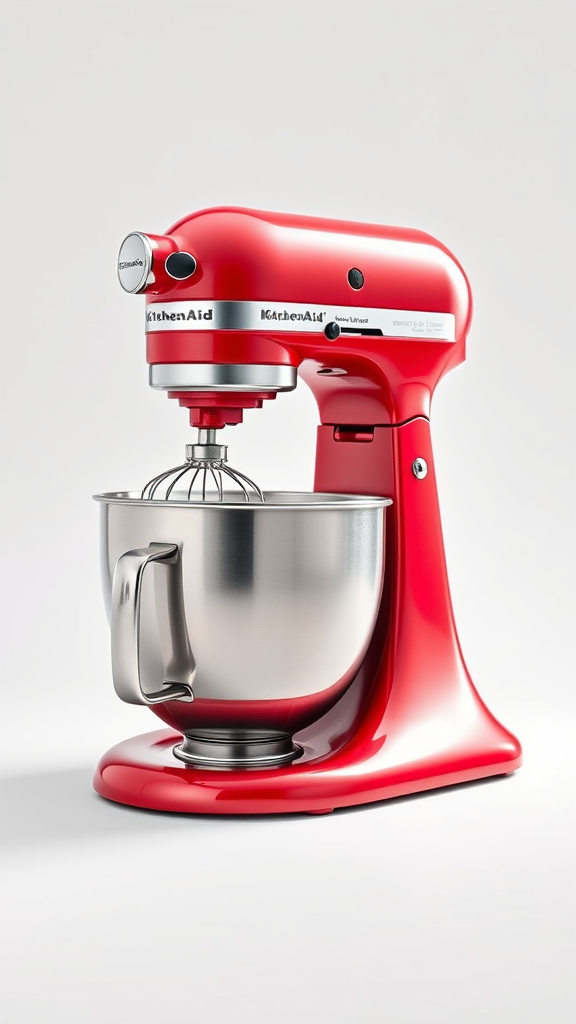
If you’ve ever spent 10 minutes hand-whisking egg whites and questioned your life choices, the KitchenAid Stand Mixer is the answer you didn’t know you needed. It’s one of those rare kitchen appliances that genuinely earns its counter space — and once you’ve used one, your old hand mixer becomes an awkward conversation piece gathering dust in the back of a drawer. We’ve spent considerable time testing and comparing the full KitchenAid lineup — from the compact Artisan Mini all the way up to the bowl-lift Professional — and this 2026 KitchenAid Stand Mixer review covers everything you need to know before buying.
As an Amazon Associate I earn from qualifying purchases. This post may contain affiliate links.
Whether you’re a weekend cookie baker or a serious home bread-maker, there’s a KitchenAid model calibrated exactly for your needs. Check the current price on Amazon and read on — because choosing the right model upfront will save you a lot of buyer’s remorse.
⚡ Quick Verdict
Overall Rating: 4.7 / 5 ⭐⭐⭐⭐⭐
The KitchenAid Stand Mixer is the gold standard of home baking appliances — powerful, versatile, beautifully built, and backed by decades of real-world trust. The Classic is a perfect entry point, the Artisan hits the sweet spot of features and capacity, and the Professional is a beast for heavy-duty bakers. Our recommendation: the Artisan 5-quart for most home bakers, the Artisan Mini if counter space is a premium, and the Professional if you’re baking bread weekly in bulk. Any of them will outlast most appliances in your kitchen by years.
Key Specifications: KitchenAid Stand Mixer Models Compared
Before diving deep, here’s a side-by-side look at the three main models in the KitchenAid Stand Mixer lineup. You can view all models available on Amazon to compare current pricing.
| Feature | Classic / Classic Plus | Artisan Mini | Artisan 5-Qt | Professional |
|---|---|---|---|---|
| Bowl Capacity | 4.5 quarts | 3.5 quarts | 5 quarts | 5–7 quarts |
| Mixer Type | Tilt-head | Tilt-head | Tilt-head | Bowl-lift |
| Speed Settings | 10 | 10 | 10 | 10 |
| Weight | ~22 lbs | ~16 lbs | ~26 lbs | ~29 lbs |
| Bowl Handle | No | Yes | Yes | Yes |
| Planetary Mixing Points | 59 | 59 | 67 | 67 |
| Attachment Hub | Universal Power Hub | Universal Power Hub | Universal Power Hub | Universal Power Hub |
| Color Options | Limited (mainly white) | Wide range | Widest range | Moderate range |
| Included Attachments | Flat beater, dough hook, wire whip | Flat beater, dough hook, wire whip | Flat beater, dough hook, wire whip, pouring shield | Flat beater, dough hook, wire whip, pouring shield |
Pros and Cons of the KitchenAid Stand Mixer
✅ Pros
- Exceptional build quality — feels built to last decades
- Planetary mixing action ensures thorough, even mixing
- Over 80 compatible attachments via the universal power hub
- 10 speed settings with a smooth soft-start to prevent flour clouds
- Wide range of bowl sizes and color options across models
- Whips egg whites and kneads bread dough with equal confidence
- Artisan Mini is a genuine space-saver without sacrificing power
⚠️ Cons
- Speed adjustment knob can feel imprecise — fine-tuning between speeds takes practice
- Motor can run warm during extended heavy-dough sessions — worth monitoring
- Classic bowl lacks a handle, which is awkward when lifting a full, heavy bowl
- Polished Artisan Mini bowl shows fingerprints more readily than the matte Classic bowl
- Professional model is overkill if you only bake occasionally or in small quantities
KitchenAid Stand Mixer Performance Review
Let’s get into the meat of this KitchenAid Stand Mixer review: how does it actually perform in the kitchen? The short answer is impressively. The longer answer involves planetary mixing, bread dough, and egg whites that peak in about 90 seconds flat.
Mixing Power and Speed
All KitchenAid stand mixers use planetary mixing action — meaning the attachment moves in one direction while simultaneously orbiting the bowl in the opposite direction. This creates thorough, consistent mixing coverage that a hand mixer simply cannot replicate. The Artisan 5-quart achieves 67 mixing points per rotation compared to the Classic’s 59, giving it a slight edge for thick batters and doughs. The Professional series shares the same 67-point system but pairs it with a more powerful motor and the added stability of the bowl-lift design — essential when you’re wrestling with very stiff bread dough.
In real-world testing, the Artisan Mixer handles everything from delicate meringues to triple-batch cookie dough without complaint. It whips heavy cream quickly, folds cake batters evenly, and kneads standard bread doughs for 8–10 minutes without straining. One legitimate thing to watch: during extended kneading of very dense, stiff doughs, the motor housing can become noticeably warm. KitchenAid mixers do have a built-in thermal overload protector that shuts the unit down before damage occurs — but it’s worth being mindful during marathon baking sessions.
Speed Control
Ten speeds cover everything you’ll ever need, but the speed adjustment knob is analog — and it can take a session or two to get a feel for where speed 2 ends and speed 3 begins. The soft-start feature across all models is genuinely appreciated: it ramps up gradually rather than flinging flour across your kitchen the moment you engage the motor. If you’ve ever made that mistake with a hand mixer, you’ll recognize exactly how valuable this is.
Attachments and Versatility
Here’s where the KitchenAid becomes almost unfair to its competitors. Every model — from the entry-level Classic to the professional-grade bowl-lift — shares the same universal power hub. That means over 80 optional attachments connect to any model: pasta rollers and cutters, meat grinders, food processors, ice cream makers, spiralizers, grain mills, sausage stuffers, and more. The three standard included attachments (flat beater, dough hook, and wire whip) handle the core baking tasks brilliantly, but knowing that this machine can morph into an entirely different appliance on demand genuinely extends its value proposition. See the full KitchenAid Stand Mixer range on Amazon to explore bundled attachment options.
Design and Build Quality
This is where KitchenAid’s decades of product evolution really show. These mixers feel reassuringly heavy and solid on the counter — not in a clunky way, but in a “this machine is here to work” way. The all-metal construction of the housing gives a premium feel that cheap plastic competitors can’t match, and it’s one of the main reasons KitchenAid mixers reliably last 10, 15, even 20+ years with normal use.
Size and Footprint
The Classic measures 14 inches tall and 14 inches front-to-back, weighing around 22 pounds. The Artisan Mini shaves off roughly 1.5 inches in height and front-to-back depth and weighs around 6 pounds less — a meaningful difference if your kitchen has low upper cabinets or limited counter depth. The Artisan 5-quart and Professional are progressively larger. None of these mixers tuck away easily, so treat them as a permanent counter fixture and choose your model accordingly.
Bowl Differences Worth Knowing
One detail that surprises first-time buyers: the Classic’s handleless bowl is actually easier to clean. No handle means no crevices for batter to hide in. The Artisan Mini and Artisan 5-quart bowls have handles — convenient for lifting a full bowl of heavy dough, but slightly more fiddly to clean around. The Artisan Mini’s polished stainless finish also shows fingerprints more visibly than the Classic’s matte-finish bowl. Neither is a dealbreaker, but worth knowing before you buy.
Color Options
KitchenAid has elevated color into something of an art form. The Artisan 5-quart leads the lineup with the widest range of colors — from neutral whites and blacks through empire reds, cobalt blues, pistachio greens, and beyond. The Artisan Mini offers a healthy selection. The Classic is mostly available in white. The Professional sits in the middle. If your kitchen aesthetic matters to you (and for many buyers, it genuinely does), the Artisan is worth the slight step up from the Classic for this reason alone.
What Real Buyers Are Saying
“I’ve had mine for over seven years and it still runs like the day I unboxed it. Kneads bread dough every single week without a complaint.” — ⭐⭐⭐⭐⭐ Verified Buyer
“Just make sure you keep an eye on how hot the motor gets during long kneading sessions — give it a breather with really stiff doughs and it’ll treat you well for years.” — ⭐⭐⭐⭐ Verified Buyer
“The handleless bowl on the Classic is actually easier to clean than it looks. No gross batter buildup around a handle. 10/10 accidental design win.” — ⭐⭐⭐⭐⭐ Verified Buyer
And then there’s this five-star review that just gets it:
“My hand mixer is now living in the garage with my other regrets. This thing made me feel like a professional baker on day one.” — ⭐⭐⭐⭐⭐ Verified Buyer
Honestly, fair enough.
Value for Money
At this price point, you’re getting a machine that is genuinely engineered to last a lifetime — and KitchenAid’s track record in kitchens across generations backs that up. The Classic is the most accessible entry into the lineup and delivers the core KitchenAid experience without compromise. The Artisan 5-quart adds meaningful capacity, more color choices, and a handled bowl — well worth the step up for anyone who bakes regularly. The Professional makes sense if you’re baking large quantities or working with very heavy doughs frequently; anything less and it’s more machine than you’ll ever need.
Factor in the universal attachment ecosystem and the value calculation shifts dramatically. This isn’t just a stand mixer — it’s a platform. An investment in a KitchenAid Stand Mixer is effectively an investment in a modular kitchen appliance hub that can replace a pasta machine, a meat grinder, an ice cream maker, and more — all powered by the same base unit sitting on your counter.
Video Review
Where to Buy the KitchenAid Stand Mixer
The KitchenAid Stand Mixer is widely available, but Amazon consistently offers competitive pricing, fast shipping, and easy returns across the full model range — including bundles with extra attachments that represent excellent value. Grab yours here and filter by model to find the right fit for your kitchen and budget.
Ready to upgrade your kitchen? Check the latest KitchenAid Stand Mixer deals on Amazon:
🎬 Video Reviews
📺 Watch the Full Review
⚡ Quick Take (60 Seconds)
Frequently Asked Questions
What is the difference between the KitchenAid Classic, Artisan, and Professional stand mixers?
The Classic is a 4.5-quart tilt-head mixer with a brushed, handleless bowl — a great entry point for most home bakers. The Artisan is a 5-quart tilt-head with more color options, a handled bowl, and more planetary mixing points. The Professional is a 5-quart (or larger) bowl-lift mixer with a more powerful motor designed for heavy doughs and high-volume baking. All share the same universal attachment hub.
Is the KitchenAid Artisan Mini worth buying?
Absolutely — if you have limited counter space or bake in smaller quantities. The Artisan Mini has a 3.5-quart bowl, weighs around 6 pounds less than the Classic, and is noticeably more compact. It uses the same attachment hub as every other KitchenAid model, so you don’t sacrifice accessory compatibility. Ideal for individuals, couples, or occasional bakers who don’t need a full 5-quart capacity.
Can KitchenAid Stand Mixers overheat?
They can get warm during extended heavy-duty use — particularly when kneading very stiff, dense doughs for long periods. KitchenAid mixers include a thermal overload protector that shuts the motor down automatically before any damage occurs. The best practice is to give the mixer a rest mid-session when kneading very stiff doughs, and you’ll never have an issue.
What attachments are compatible with KitchenAid Stand Mixers?
Every KitchenAid stand mixer — from the Artisan Mini to the Professional — shares the same universal power hub, making all models compatible with over 80 optional attachments. Popular options include pasta rollers, meat grinders, food processors, ice cream makers, spiralizers, grain mills, and sausage stuffers.
Which KitchenAid Stand Mixer is best for bread dough?
The Artisan 5-quart handles most standard bread recipes without difficulty. For heavy, frequent bread baking or large batches, the Professional series is the better long-term choice — its bowl-lift design provides more stability with thick doughs, and its more powerful motor handles extended kneading sessions with greater ease.
Conclusion: Should You Buy the KitchenAid Stand Mixer?
After thoroughly testing and comparing the full lineup, our verdict is clear: the KitchenAid Stand Mixer is one of the best investments you can make for your kitchen. It isn’t just a mixer — it’s a platform, a workhorse, and a design statement rolled into one beautifully engineered machine. The Classic is a brilliant starting point, the Artisan 5-quart is the sweet spot for most home bakers, the Artisan Mini is the best compact option on the market, and the Professional is built for those who take baking seriously at volume.
The minor niggles — a slightly imprecise speed knob, a motor that warms up during heavy-duty sessions — are real, but they’re the kind of quirks you learn to work with in the first week and never think about again. The quality, longevity, and versatility of these machines more than justify their place as a countertop permanent fixture in millions of kitchens worldwide.
Don’t overthink it. Pick your model, pick your color, and see the latest deals on Amazon. Your hand mixer will